Some Thoughts From The Filene AI Panel

It was an honor to be part of the discussion panel for Filene Research Institute’s webinar, “Designing Digital Experiences That Work: Why Data Is the Foundation for Reliable AI.” Royce Wu of Filene hosted, Gerald (Jerry) Kane of the University of Georgia moderated, and I was on the panel with Ben Maxim, CTO of MSUFCU, and Dean Valoras of Illyrian Consulting.
I enjoyed being part of this panel because the two gentlemen I was with were sharp and really brought a lot of value to the conversation. I find myself navigating through uncertain, uncharted territory, and it was great to see how each one of us is approaching it differently, but with the same mindset of what’s in the interest of our members and our organizations first. We also share the view that shying away from a new technology like AI is not the answer.
Where I think credit unions go wrong is not thinking through what this technology means. When the big data movement started ten or fifteen years ago, it was all about breaking the silos. Now every single vendor has an AI solution you have to use in their particular environment, and we run the risk of siphoning our data right back into silos. You’re only going to be as good three years down the road as the foundation you lay down today. At Rize, we spent nine to ten months getting our data lake where it needed to be before we even started plugging AI into it. Ben went a different direction with Snowflake and a partner, and Dean’s point holds for both of us: you have to know your data inside out and have it well classified.
Ben made a really interesting comment that you don’t hear in credit union meetings too often, which is speed to market. The reason we are behind as an industry is not because we lack the ideas or the talent. It’s that we don’t move fast enough to get it out there.
On shadow AI, look, it’s always going to be out there. If you try to block it out altogether, it’s whack-a-mole. The easiest way to handle it is to turn on the floodlights and put everything in the light. If you want to use ChatGPT to plan your vacation, I’m not going to block that, but I can block you from uploading member data.
What’s different this time is who’s doing the building. Gartner calls them citizen developers, employees outside of IT who build their own applications with whatever tools IT hasn’t forbidden, and Gartner is clear that it’s a persona, not a job title. For years that meant someone in operations building a workflow in a low-code platform. Now it’s anyone with a prompt and a tool like Claude or ChatGPT. Back in 2022, Gartner predicted that by this year at least 80 percent of the people using low-code tools would sit outside formal IT. Ben compared AI to Excel on the panel, and he’s right. Excel has been shadow IT for thirty years, and nobody ever solved that by taking Excel away.
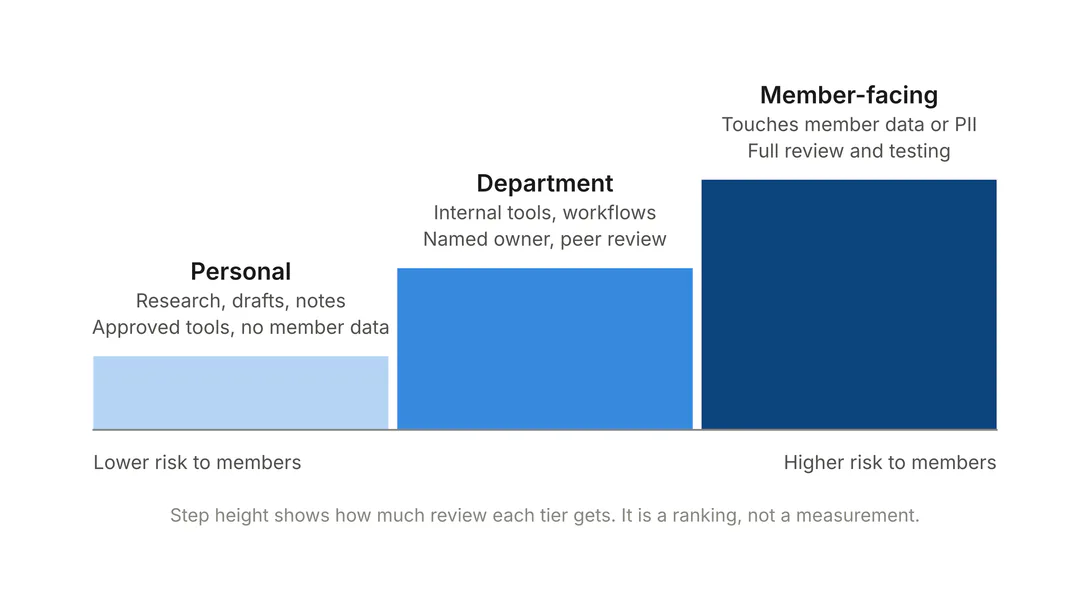
So the answer isn’t to block it, it’s to tier it. Someone building a personal tool off public research shouldn’t go through the same review as an app that touches member data, and anything member facing gets the full treatment. Gartner’s own guidance lands in the same place, keeping unsupervised AI building to prototypes and noncritical internal tools.
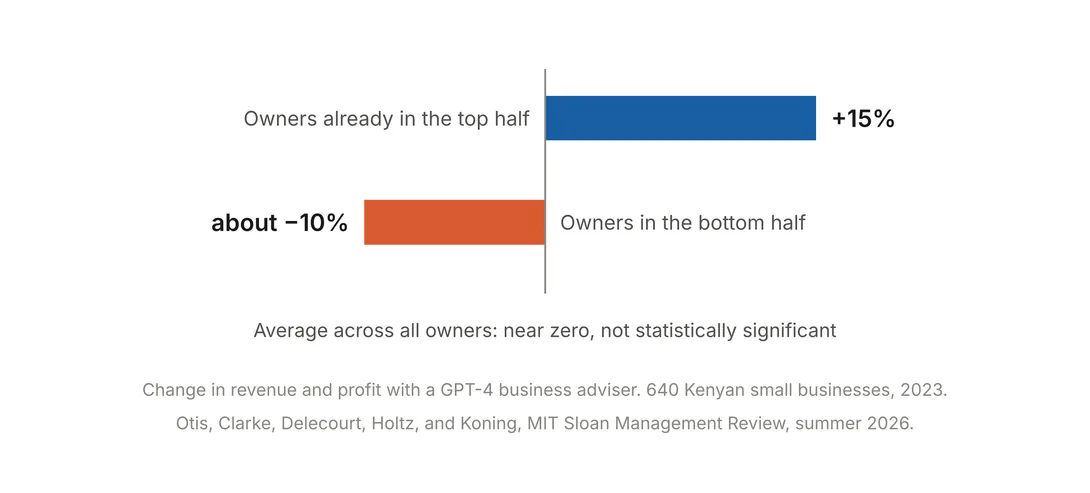
The other half is knowing who your power users are and who your weak users are. AI in the hands of someone who doesn’t know the business is more dangerous than not having it at all, because they can’t tell when it’s wrong. Research published this summer in MIT Sloan Management Review makes the point better than I can. Researchers gave hundreds of small business owners in Kenya an AI business adviser. The owners who were already doing well saw revenue and profits rise about 15 percent, and the ones who were struggling saw them fall nearly 10 percent. They asked the same questions and got the same advice. The difference was judgment, knowing which advice to act on and which to ignore. That’s the risk worth governing, not the person experimenting on the side.
If you’re asking what to do in the next six months, get AI into everyone’s hands as fast as possible. It’s no different than knowing how to use Word and Excel. The longer you wait, the harder it’s going to be to close that gap, and it’s building fast.
Thank you to Filene, Royce, and Jerry for having me, and to Ben and Dean for a great conversation.
Sources
- Filene Research Institute, “Designing Digital Experiences That Work: Why Data Is the Foundation for Reliable AI,” webinar, November 5, 2026. https://www.filene.org/events/designing-digital-experiences-that-matter-why-data-is-the-key-for-credit-unions
- Otis, Clarke, Delecourt, Holtz, and Koning, “How AI Helps the Best and Hurts the Rest,” MIT Sloan Management Review, summer 2026. https://sloanreview.mit.edu/article/how-ai-helps-the-best-and-hurts-the-rest/
- Gartner Glossary, “Citizen Developer.” https://www.gartner.com/en/information-technology/glossary/citizen-developer
- Gartner press release, December 13, 2022: low-code forecast, 80% of users outside formal IT by 2026. https://www.gartner.com/en/newsroom/press-releases/2022-12-13-gartner-forecasts-worldwide-low-code-development-technologies-market-to-grow-20-percent-in-2023
- OutSystems summary of Gartner research, “Why AI Won’t Replace the Need for Low-Code Application Platforms.” https://www.outsystems.com/1/low-code-ai-platforms-gartner