Connecting the Dots
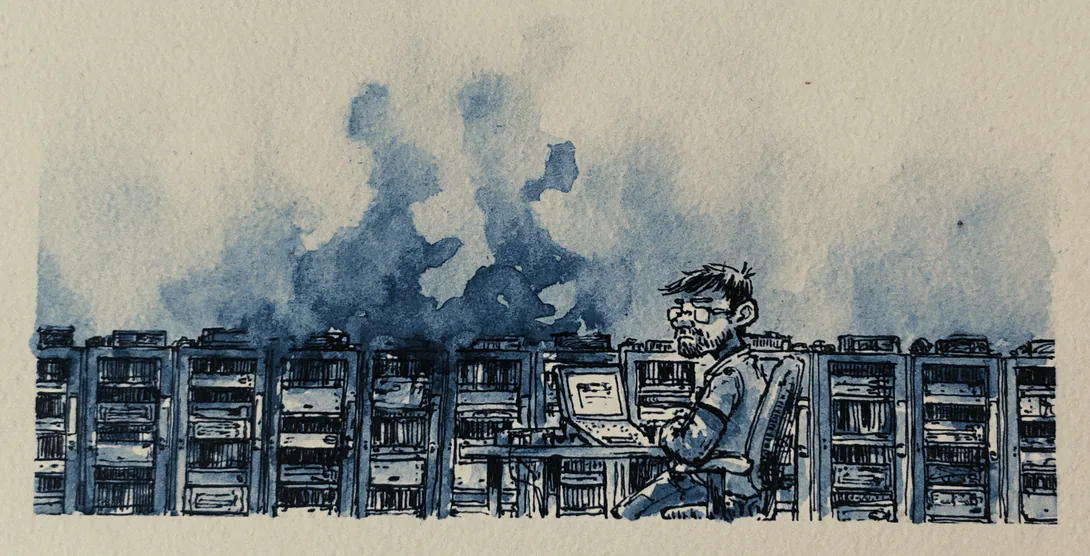
Over six days this month, Microsoft Outlook, the FAA, Chase, the NSA, and Apple all went down. The best explanation I have heard so far did not come from a government briefing. It came from Mo Bitar, a developer I follow on X, in an 11-minute video he posted on November 18. He nailed it, and frankly he did a better job explaining what happened than our own government has.
Mo’s short version is that none of these outages were attacks. Each one traces back to a fix, an upgrade, a release, a patch, or an update the organization made itself. He backs that up with the public record of the past year. AI companies and security leaders warned that AI would find vulnerabilities faster than anyone could patch them. Banks and AI companies pushed everyone to shorten testing and ship fixes faster. Security researchers warned that patching fast and patching safely are at odds. Watch his video for the full set of sources. It is also very funny; he is a clever guy.
The numbers Mo cites tell the story on their own, and the chart below follows:
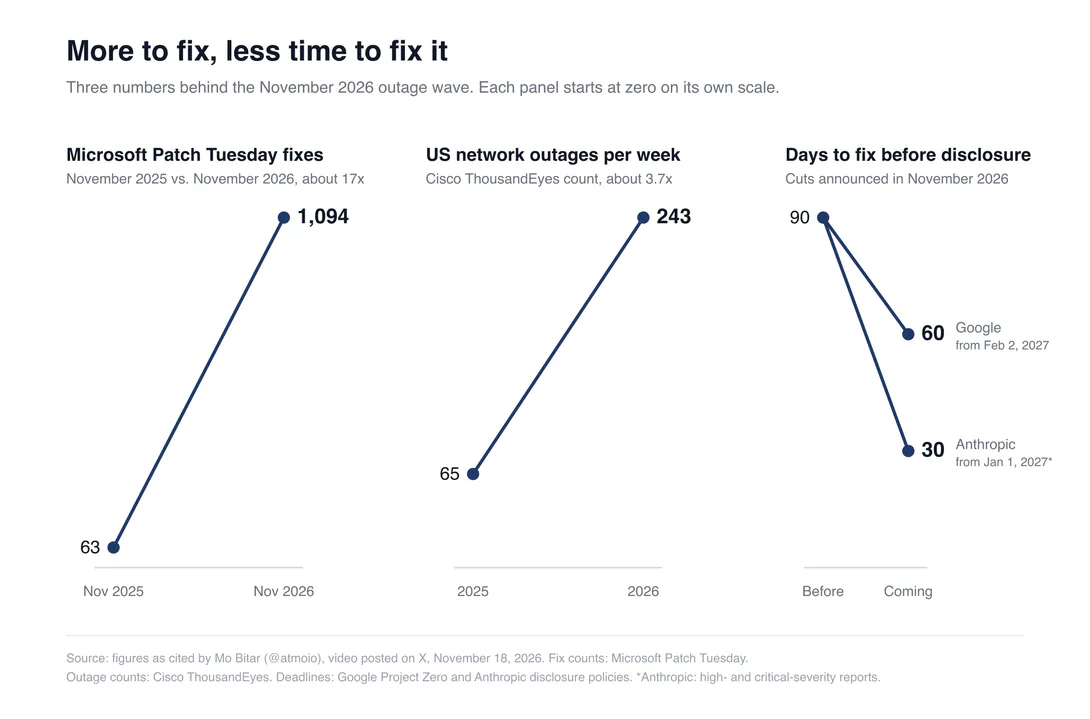
Put in that context, Mo’s explanation makes a lot of sense. That context is exactly why we are seeing such a rise and spike. It is a perfect storm of sorts. I know that has become such a cliché these days, but it is.
A rational explanation is not a clean bill of health
I still do not think we should discount a cyberattack, and some of these incidents might be one. If anything, the bad actors and anyone else looking to create havoc are incentivized by this moment. Everyone is rushing to patch, which makes it a good time to poke holes and see what they can get away with.
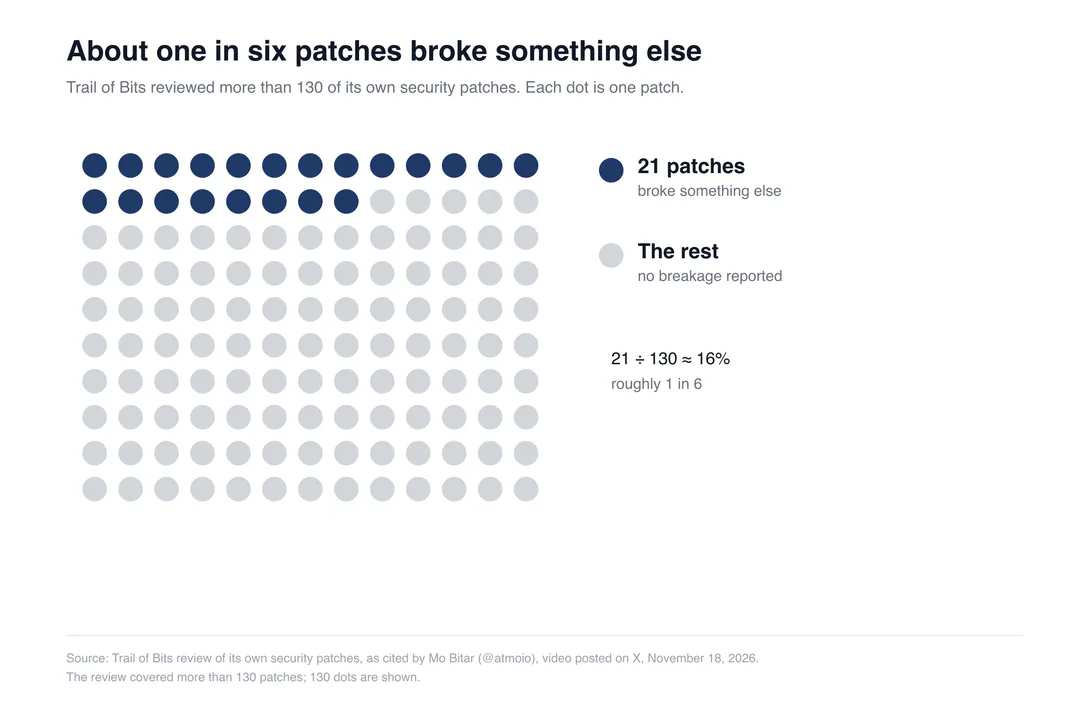
Still, most of this is the result of unintended consequences and untested patches. Anyone in IT will tell you how it goes. You roll out the first patch or an upgrade to macOS, and within the first four weeks half your applications do not work and you are installing new updates. One firm’s review of its own patches makes the same point, shown in the next chart:
The dots nobody official connected
It is a shame that our government officials do not put more effort and time into connecting the dots for people. Reassuring the public that there is no attack, when there is not one, matters. They should also say plainly that this is what happens when you start panicking people and pushing ideas about runaway AI. The AI is not running away. It is lowering the barrier to entry, and we have a lot of people who are really interested in causing havoc.
What I would ask of my peers
None of this removes the risk, and it does not remove the anxiety. What it gives me is clarity on how to think about this proactively. I hope my peers in the industry do the same. That applies to how they communicate with leadership and staff in their own organizations, and to how they react to and coordinate the work of securing our environments.
Sources
Bitar, M. [@atmoio]. (2026, November 18). Wtf is happening to the internet? [Video]. X. https://x.com/atmoio/status/2123147431458017568 (also on YouTube: https://www.youtube.com/watch?v=LD4a9IpoLMQ). All chart figures are as he cites them.
EoM