Nobody Joins a Credit Union Because They’re Eligible

While doing my usual morning research of what’s going on in the world I came across a 2012 TEDxBoston talk by Clayton Christensen (Christensen, 2012). I never had the chance of meeting the man but my career was heavily influenced by a lot of his work, starting with The Innovator’s Dilemma; specifically his work taught me how to think about business, innovation, and how you can make all the right decisions but still get the wrong outcomes. In this talk Christensen described himself the way a marketing database would. Sixty years old. Lives in the suburbs. Five kids, all grown and gone. He then made a point that hit me between the eyes; someone with that profile might be statistically more likely to buy The New York Times, but none of those traits causes him to buy it. What causes a purchase is a job that comes up in someone’s life, and a product they can “hire” to get it done.
So in keeping in line with Christensen’s observation and applying my lessons learned from him, I decided to ask, why would someone choose a credit union over a neobank, a payment app, or a fintech lender? Most of us instinctively probably answer with characteristics. Member-owned. Not-for-profit. Local. Better rates. Those things are true, and they matter. But they are descriptions of us, not jobs we do for anyone. Nobody joins a credit union because they’re eligible, any more than Christensen bought the Times because he turned 60.
Christensen’s Theories
Throughout his career, Christensen built theories, which he defined simply as statements of what causes what, and why. And three of them provide context for much of what is happening to the credit union industry right now. What follows are three examples from his 2012 TEDx talk, based on some of his theories, with real-world examples.
The Cisco Story
Christensen notes that Lucent and Nortel dominated with high-end voice equipment. Cisco’s router wasn’t good enough for voice, so Cisco started at the bottom with data traffic, improved every year, moved upmarket, and displaced both leaders. When the incumbents looked at the router, it was worse on every measure they tracked, so they kept improving their products for their best customers.
Personal lending followed a similar curve. Fintech lenders held under 1% of personal loan balances in 2010 (Bank Innovation, 2017). By 2018 they held 38%, and credit unions’ share fell from 31% to 21% in just five years (TransUnion, 2019). Today fintechs account for roughly 45% of new personal loan originations (TransUnion, 2026).
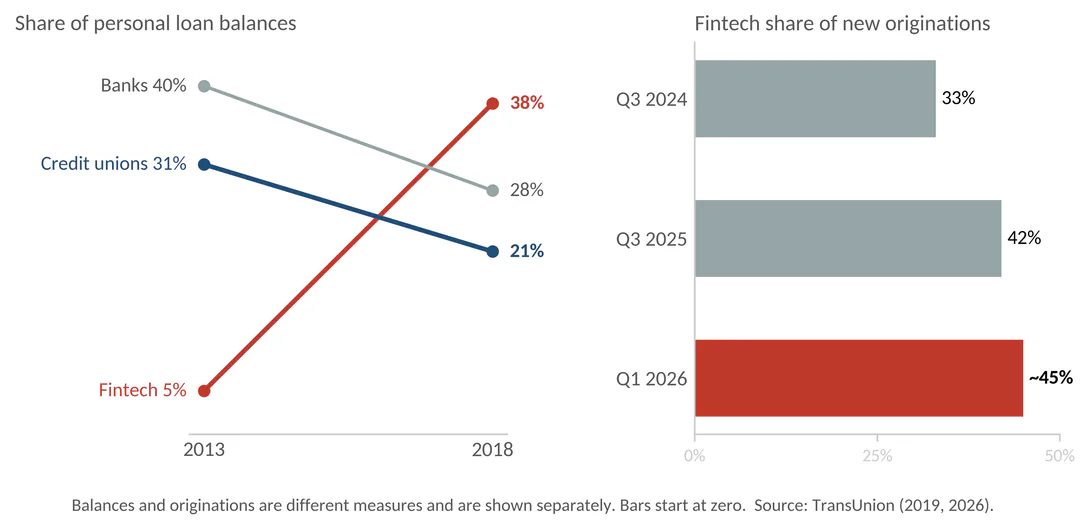
In 2018 the average credit union personal loan was about $5,300, almost half the fintech average (TransUnion, 2019). Small, fast credit for everyday people was a credit union job (as defined by Christensen). The entrants didn’t pick up something we had abandoned. They took something we were doing and did it with less friction.
Personal loans aren’t the end of it. Payment apps, early wage access, and buy-now-pay-later all started with jobs that looked too small to matter. Now more than half of Gen Z uses buy-now-pay-later, a slightly higher share than uses credit cards (Jack Henry & Associates, 2026). My expectation is that deposits and auto lending come next. That is a forecast, with no data behind it, but the direction of travel isn’t ambiguous.
Nobody decided this
Christensen asks a pointed question about Lucent: who decided the company should die, and on what date? The answer is nobody. Every person did what made sense in their own role, and the sum of those sensible choices was collapse. The cause is how organizations measure returns. Payoffs that arrive next year feel real. Payoffs that arrive in a decade lose every budget fight.
Credit unions make these choices every planning cycle. A branch remodel has a visible payback. Indirect auto volume hits the growth target, even though the dealer owns the relationship. Fee income closes the gap this year. Deferring the digital rebuild saves money now, and the cost of waiting never shows up on a report. Each of these would survive a board review.
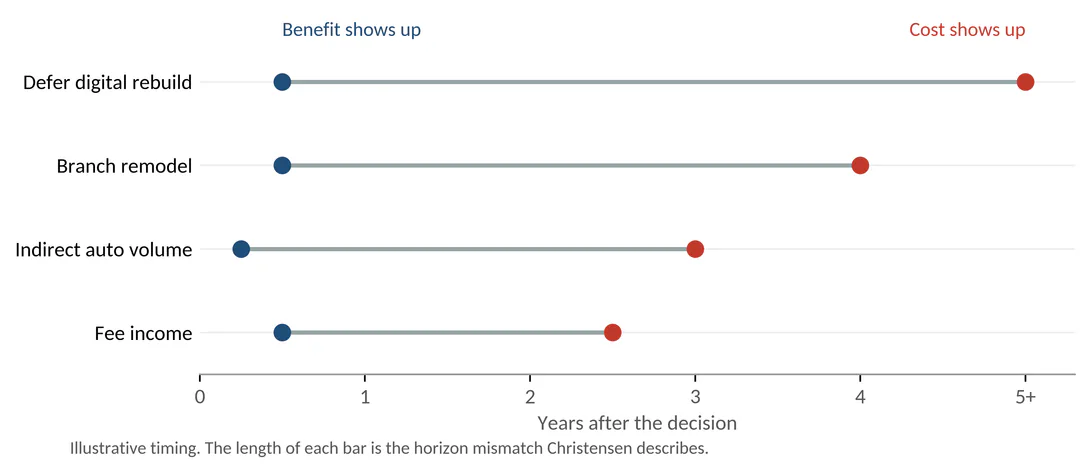
The problem isn’t any single decision. It’s that each one is judged when its benefit arrives, and its cost lands outside the window anyone is measuring. Added together, those choices become the strategy, whether anyone chose it or not.
The job decides
Most of what credit unions know about members is characteristics: age, ZIP code, employer, tenure, products held, credit tier. Those correlate with behavior. They don’t cause it. Ron Shevlin put it bluntly in 2022, citing Cornerstone Advisors data: credit unions were losing ground in primary checking, and their “we have nicer people, and we’re not-for-profit” story wasn’t resonating (Shevlin, 2022).
Look at three ordinary moments from the job side instead of the profile side.
A member’s car dies on a Friday, and she needs $1,800 by Monday to get to work. The job is to get money she can trust, fast, without feeling judged. She’ll hire whoever gives her a credible yes first. If a fintech app approves her in minutes and her credit union’s process runs into Tuesday, nine years of membership don’t factor in.
A 23-year-old needs to send his roommate $650 for rent tonight. The job is to settle up without awkwardness. He uses the payment app that’s already on both their phones. That job never reaches his credit union at all, and every job a credit union is never hired for is a habit being built somewhere else.
A member walks onto a dealer lot to buy her first car. The job is to not get taken advantage of. Credit unions can win this one outright with a pre-approval, a clear rate, and someone on her side. But when the loan arrives through the dealer’s indirect channel, the dealer gets credit for the job, and the credit union becomes an invisible source of funding.
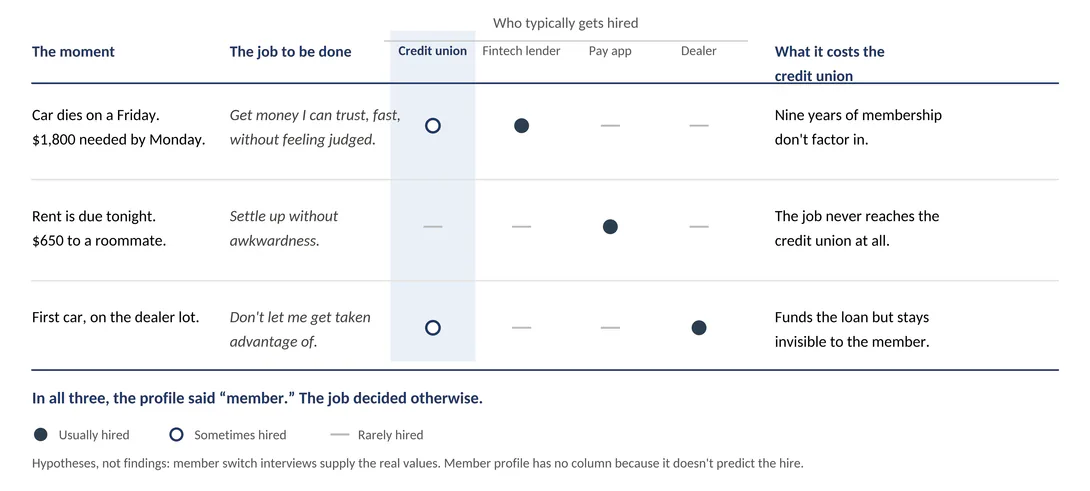
Lay those three moments side by side and the pattern is hard to miss. The credit union column is mostly empty, and not because the products are bad. It’s empty because we’re rarely the thing that gets hired at the moment the job shows up.
Now let’s extend this exercise into today’s world of AI and Agentic systems: why would someone else’s agent choose our credit union? If members start handing routine financial decisions to AI agents, like where to keep their savings or which lender to use for the next car, then the member is no longer the one doing the choosing. Where that leads is honestly unclear, and I’m wary of how much of the industry’s attention AI is already absorbing. But the logic points in one direction. An agent has no attachment to eligibility, a branch, or a mission statement. It—the agent—hires whoever can do the job, on terms it can read and verify. In a sense, an agent is Christensen’s job-to-be-done stated precisely and carried out without the inertia that has quietly protected incumbents for decades. The institutions that are clearly best at a specific job will get hired again and again, automatically, and that advantage compounds into a wider moat. And those still leaning on characteristics may find there is nothing on their pages for the agent to choose.
So what?
The question “why would someone choose a credit union?” is the wrong question, because it invites an answer about us. The better question is: what jobs come up in our members’ lives where we are clearly the best thing to hire, and where are we being fired?
Three moves get a credit union started on answering it.
First, talk to the members who left. Sit down with fifteen or twenty members who recently took a fintech loan, opened a neobank account, or moved their direct deposit. Reconstruct the moment they switched: what happened, what were they trying to get done, and what else did they consider? This is how Christensen’s own teams uncovered jobs, and it costs almost nothing.
Second, pick one job and win it end to end. Not a product, a job. Helping a first-time car buyer walk off the lot without getting fleeced is a job the cooperative model is built for. Design the whole experience around that moment.
Third, protect the long horizon on purpose. Set aside a defined share of the strategy and technology budget that doesn’t have to beat a twelve-month payback. Otherwise the decision to defer will keep getting made by default.
Eligibility gets someone to the door. The job is what gets them to walk through it.
EoM
References
Bank Innovation. (2017, November). Fintechs have a larger share of personal loans than banks or credit unions. https://bankinnovation.net/2017/11/fintechs-have-a-larger-share-of-personal-loans-than-banks-or-credit-unions/
Christensen, C. M. (1997). The innovator’s dilemma: When new technologies cause great firms to fail. Harvard Business School Press.
Christensen, C. M. (2012). How will you measure your life? [Video]. TEDxBoston.
Christensen, C. M., Hall, T., Dillon, K., & Duncan, D. S. (2016). Competing against luck: The story of innovation and customer choice. HarperBusiness.
Jack Henry & Associates. (2026). The Gen Z imperative: Capturing 2026’s 4 million new accounts [Infographic]. https://www.jackhenry.com
Shevlin, R. (2022, March 1). The growing domination of Chime, Square Cash App, and PayPal in checking accounts. Forbes. https://www.forbes.com/sites/ronshevlin/2022/03/01/the-growing-domination-of-chime-square-cash-app-and-paypal-in-checking-accounts/
TransUnion. (2019). FinTechs continue to drive personal loans to record levels [Press release]. https://newsroom.transunion.com/fintechs-continue-to-drive-personal-loans-to-record-levels
TransUnion. (2026). Q2 2026 credit industry insights report: Consumer lending. https://media.transunion.com/content/dam/transunion/us/business/collateral/report/1-fs/q2-2026-ciir-consumer-lending-report.pdf