The Zero in the Equation, Part Two

In Part One, I elaborated on observations made by Michael Hammer and Shoshana Zuboff and expanded on them by noting that individuals’ ambitions lead them to think three-dimensionally and unlock unrecognized value. Now I will expand on why leaders have a responsibility to their staff, their organizations, and ultimately their customers to enable and nurture their teams, unlocking their creativity and, in the process, their ambitions. Most of what looks like a lack of creativity is a lack of permission to be creative, and the difference matters a great deal for what you do about it.
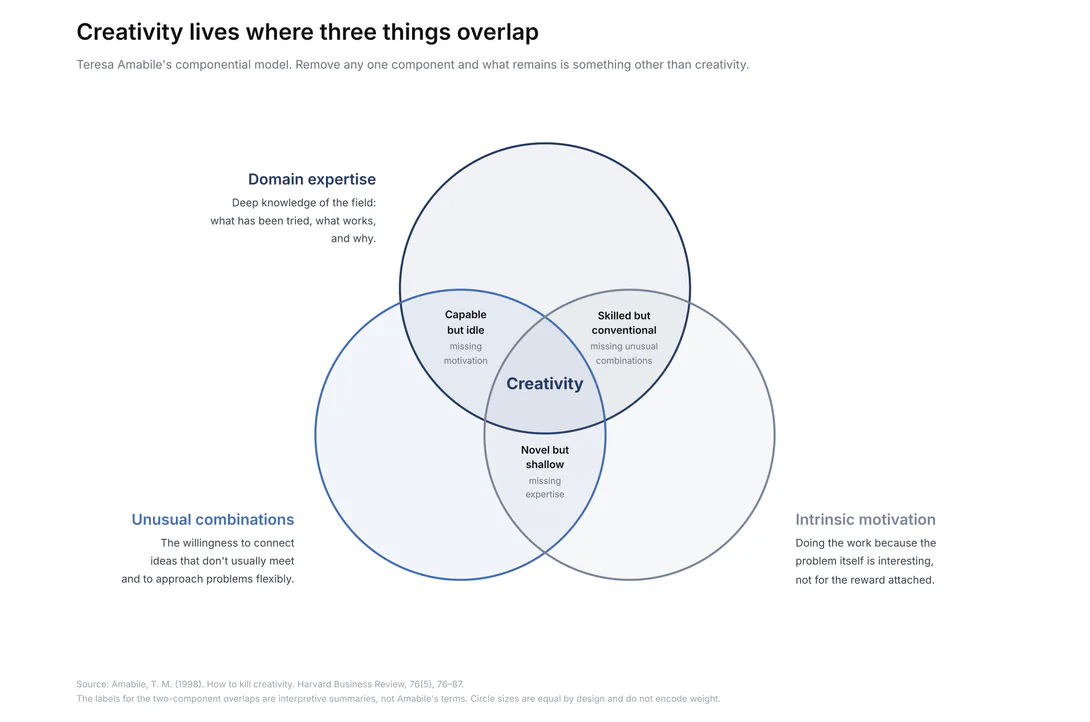
Teresa Amabile at Harvard Business School has spent more than four decades studying creative work inside organizations. She found that creativity requires three things in combination: domain expertise, the willingness to combine ideas in unusual ways, and intrinsic motivation, which means wanting to solve the problem for its own sake. Most corporate environments quietly destroy the third one. Every task becomes a deliverable with a deadline and a status report, and over time people learn that the safe move is to look busy on visible tasks, because the risky move is to attempt something that might not work. AI does not fix that. It makes it worse, because now the look-busy crowd has a shiny new instrument to look busy with.
Any reasonably motivated person will learn to navigate a tool in a weekend. Leadership’s job is to raise the ambition side of the equation, and I have three ideas for leaders who want to do it.
1. The “ten of you” exercise
Gather the team and ask each person to write down, privately, what they would attempt this quarter if they suddenly had ten clones of themselves. Same skills, same knowledge, just ten times the hands. The constraint is the point of the exercise: a checklist does not need ten people, and updating tickets does not need ten people. The only ideas that survive the constraint are ideas with real ambition.
People will say things like, “I would sit down with every member we declined for a loan this year and build each of them a plan to qualify within twelve months.” Or, “I would find every member paying overdraft fees or carrying high-interest debt somewhere else and show each of them a better option we already offer.” Or, “I would build a version of our website and member materials in every language our members speak at home.” Those are 3D projects, and they were sitting in your team’s heads the entire time because nobody had ever asked.
Then you make the move that breaks the exercise wide open. You tell them, “AI is roughly equivalent to having ten of you for certain kinds of work. The hypothetical you just described is not hypothetical. Go do it.”

2. Raise the imaginative ceiling
People cannot imagine what they have never seen. One of the reasons your team is producing fancier checklists is that fancier checklists are the most ambitious thing they have personally witnessed someone do with AI. They have no mental library of what 3D looks like, so you build one for them.
When I first drafted this section, my own examples were 2D: the same contract review I have done for years, only faster. If someone who spends his days thinking about this defaults to the flat plane, imagine where your team starts.
Once a week, run a fifteen-minute live demonstration of something genuinely non-obvious. This is not a tutorial; it is a demonstration of scope, and the best ones take a job nobody could ever staff and do it in front of the room.
Inside your approved AI environment, pull the list of members whose direct deposit stopped in the last ninety days and have Claude draft a personal outreach to each one, so the room watches a retention program that once would have needed a call center take shape before the meeting ends. Take one member’s anonymized account history and build the kind of annual financial check-up that used to be reserved for private-banking clients, then ask the room what it would mean to offer that to every member. Take an idea someone raised last month and, in fifteen minutes, produce a test plan, a mock-up, and a short member survey that could go out this week, so the team sees what it looks like to test twenty ideas a quarter instead of one a year. Take the next vendor up for renewal, put its contract next to its actual service record, and walk out with a negotiation brief built on evidence rather than a summary of clauses.
Or take three years of board packets and ask Claude to identify every strategic initiative that was announced and whether it was ever mentioned again. Suddenly the room has a “promise graveyard” nobody knew existed.
The point of these demonstrations is not to teach the tool. It is to raise the ceiling of what people believe is possible. Once someone has seen a 3D move, they can start generating their own. Before they have seen one, they genuinely cannot.
3. Protected time, with permission to fail
This one sounds soft, but it is actually the most important. The reason nobody on your team is attempting anything ambitious is that they have zero slack. Every hour of their week is already claimed by tickets, meetings, and deliverables somebody is tracking. You cannot do 3D thinking in the seams of a 2D calendar.
3M pioneered the answer to this in the 1940s with what they called “15 percent time.” Engineers were explicitly allowed to spend fifteen percent of their paid hours on projects of their own choosing, without needing management’s approval. Post-it Notes came out of that program. Google later borrowed the idea and rebranded it as 20 percent time. The mechanism is simple: when you tell a smart person that for four hours every Friday afternoon they are not allowed to work on their regular tasks, that they are allowed to fail spectacularly, and that nobody will measure them on the output, two things happen. First, they panic, because they do not know what to do with unstructured time. Second, after about three weeks, they start attempting something they have been privately curious about for months and never had permission to explore.
Not everyone will use the time well. My guess is that perhaps a third of the team will produce something meaningful, a third will waste it, and a third will quietly keep doing their regular work because they cannot help themselves. That is fine. The third who use it well will produce more value than the other two-thirds combined, and as a bonus, you will learn very quickly who your 3D thinkers actually are. You will not have to guess whom to develop and whom to replace, because the exercise tells you.
The role of leadership has changed
The thread running through all three practices is that you are not teaching creativity; you are removing the things that were suppressing it. Most people on most teams have more creative capacity than their job lets them express, and the mistake leadership makes is assuming the lack of output reflects a lack of ability. Sometimes it does. More often, it reflects an environment that has, over years, trained people that ambition is dangerous and visible busyness is safe.
The shift I want every executive reading this to internalize is that, in the AI era, the job of leadership is not to roll out training programs. The training problem is trivial. The job is to raise ambition, raise imagination, and grant permission to attempt the previously impossible. Do that, and the multiplication takes care of itself. Skip it, and you will spend the next three years watching your team produce slightly nicer checklists while your competitors quietly redefine the industry around you.
The math can be rewarding or unforgiving. The ambition side of the equation is yours to set.
EoM
Sources
Amabile, T. M. (1998). How to kill creativity. Harvard Business Review, 76(5), 76–87.
Amabile, T. M. (2013). Componential theory of creativity. In E. H. Kessler (Ed.), Encyclopedia of management theory. Sage.
MNopedia. 3M (Minnesota Mining and Manufacturing Company). Minnesota Historical Society.