The Zero in the Equation
Why most organizations get nothing back from AI, and why the tool is rarely the reason

How are you using AI?
Ask a team how they are using AI, and you may get an enthusiastic list. One person used it to write an email. Another built a really nice checklist. A third had it summarize a document. A fourth is updating tickets a little faster. Everyone is energized. Everyone reports that AI is helping. And yet, when you look at the actual output of the organization, nothing has changed. The same work is getting done at roughly the same volume, in roughly the same way, with roughly the same ambition.
Take the checklist, for example. It used to live in a notepad. Then it lived in a task app. Now it lives in Claude or ChatGPT (or whatever flavor of LLM you use). But in the end, it’s still a checklist.
This is not innovation. It is substitution dressed up in new clothing, and it has a long, well-documented history in technology adoption.
In 1990, the MIT computer scientist Michael Hammer wrote a now-famous Harvard Business Review article called “Reengineering Work: Don’t Automate, Obliterate.” He argued that companies were spending fortunes on computers and getting almost nothing back in productivity, because they were taking their existing broken workflows and digitizing them step by step. He called it “paving the cow paths.” The work was still dumb. It was just dumb at the speed of electricity.
Shoshana Zuboff, who wrote In the Age of the Smart Machine, distinguished between automating (using computers to do the existing job faster) and informating (using computers to make entirely new questions answerable and new decisions possible). N. Venkatraman at MIT Sloan created a five-level ladder in 1994 that runs from “localized exploitation” at the bottom (one department goes a little faster) to “business scope redefinition” at the top, with the technology transforming the organization into a fundamentally different organization.
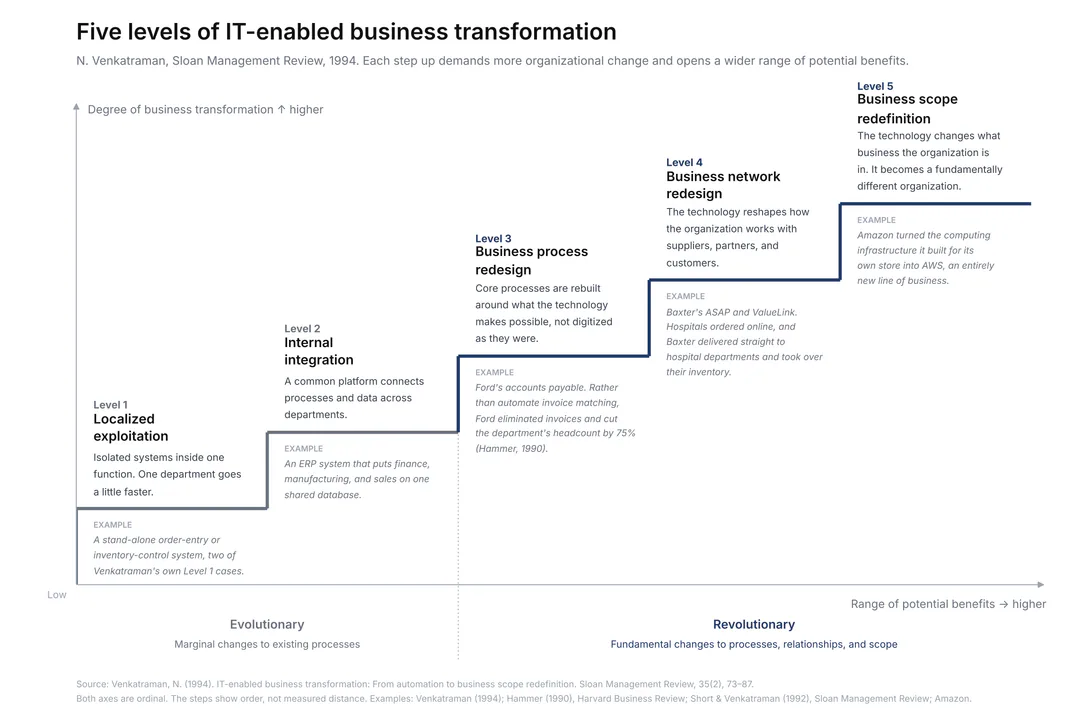
Every one of these thinkers identified the same failure mode that is now unfolding, thirty years later, across thousands of organizations with a different tool in hand. The names change. The pattern does not.
2D to 3D
I look at this problem as a mode-of-thinking issue, specifically two-dimensional thinking vs. three-dimensional thinking. In 2D space, one moves on a flat plane with two axes: speed and effort. The job stays the same; only the time and labor required to do it change. “I used to write the email by hand. Now AI writes it for me.” Same email. Same recipient. Same outcome. The only thing that moved is how long it took.
Three-dimensional thinking adds a new axis: scope, or a term I prefer, ambition. (And I define ambition in this context as the set of things you would attempt if the cost of attempting them collapsed to near zero.) A 3D thinker, an ambitious thinker, does not ask, “How do I do my current job faster?” They ask, “What could I now attempt that was previously impossible?” That question opens a door that the speed-and-effort dimension cannot. Let me demonstrate what I am thinking with some examples.
Desktop publishing, 1985. When the Macintosh and the LaserWriter arrived, most secretaries used them to type the same memos they had always typed, only in a nicer font. That was the 2D move. Paul Brainerd made the 3D move. He realized one person at one workstation could now lay out an entire magazine in a weekend, work that had previously required a typesetter, a paste-up artist, and a print shop working over three weeks. He built Aldus PageMaker and helped collapse an entire industry’s value chain into a single desk. The secretaries did not get him there. His ambition did.
Spreadsheets, 1979. Before VisiCalc, accountants did financial projections on green ledger paper. When VisiCalc arrived, the 2D users typed their existing monthly budget into a spreadsheet instead of onto paper and saved an hour. The 3D users realized they could run fifty scenarios in an afternoon. “What if rates rise two points? What if we hire ten more people? What if revenue drops fifteen percent?” In a few years, the job description of “financial analyst” had been quietly rewritten. The tool did not make accounting faster. It made an entirely new kind of thinking economically possible.

In both cases, the people who used the tool to substitute for old work captured a tiny sliver of value. The people who used it to attempt the previously unimaginable or impossible unlocked unrecognized value.
The 95% problem
In August 2025, MIT’s Project NANDA released a report called The GenAI Divide: State of AI in Business 2025, based on 150+ executive interviews, 350+ employee surveys, and analysis of 300 enterprise AI deployments across sectors. The report found that despite an estimated thirty to forty billion dollars in enterprise generative AI spending, 95% of organizations saw zero measurable impact on the profit and loss statement.
Wall Street analysts and AI skeptics immediately seized on the number as proof that the whole AI story is overhyped. I read it differently. I think the 95% number is not a verdict on the technology. It is a verdict on the thinking being applied to the technology. It is what happens when organizations take the most powerful leverage tool of our lifetime and use it to automate the writing of slightly better status reports.
The MIT researchers call the gap between the 5% and the 95% the “GenAI Divide.” They do not talk about model quality or infrastructure or talent. Instead, they focus on workflow integration, process redesign, and whether organizations are using the tool to do new work or to decorate old work. The companies in the 5% are asking what becomes possible. The companies in the 95% are asking what becomes faster. Same tools, same budgets, same access. Completely different questions. And the questions are producing a nineteen-to-one split.
And that report is consistent with what I see with clients and in my own organization. It’s not that AI does not work. It’s that most organizations are applying it in ways that mathematically cannot produce transformational returns.
10 × 0 = 0
AI is not a labor substitute; it is a leverage multiplier. Multipliers amplify whatever ambition you bring to them, including zero. Hand a 10x lever to someone whose mental model is “tasks I already do,” and they will multiply by zero, getting zero. They will produce a slightly nicer checklist. Hand the same lever to someone whose mental model is “outcomes I would pursue if I had ten of me,” and they will attempt things that were not on the table last quarter, last year, or in the company’s entire history. AI is a force multiplier whose return is mathematically bounded by the operator’s ambition.
This is the equation: 10 × 0 = 0. No amount of training, no amount of tooling, no amount of executive enthusiasm changes the arithmetic. The return on AI is proportional to the imagination of the operator. And for a meaningful share of any workforce, that proportion is currently zero.
This framing explains why two people at the same company, with the same access to the same tools, can produce wildly different results. It is not about technical skill, and it is not about prompt engineering. In multiplication, the order of the numbers does not matter; if either one is zero, the answer is zero. The tool is rarely the zero. The ambition of the person using it often is, and that is set long before anyone touches the keyboard.
When researchers say that nineteen out of twenty organizations are getting no measurable financial return from generative AI, what they are describing, underneath the jargon, is organizations that multiplied a powerful tool by an ambition of zero and were astonished to get zero. The technology did exactly what it was asked to do. The operators did exactly what they had been trained for twenty years to do, which is to look busy on visible tasks and avoid the risky move of attempting something new. And the arithmetic played out accordingly.
So here is a thought experiment I came up with, inspired by Astro Teller’s “10X Is Easier Than 10 Percent.” How can I determine if I am locked in 2D thinking vs. the ambitious 3D thinking?
Imagine you wake up tomorrow and there are ten of you, each with your skills, your knowledge of the business, and your judgment, and every one of them is ready to work on whatever you assign. Now ask yourself what you would attempt this quarter that you would never try alone. You would not put ten of yourself to work answering email faster or tidying a checklist; you would reach for the project you have been carrying around for years and quietly writing off as too much for one person, like walking into every contract renewal with a complete record of what each vendor promised and delivered, or finally answering the question nobody in your department has had time to ask. Whatever came to mind, hold onto it, because for many kinds of work, having AI is close to having those ten copies of you, and the only thing still standing between you and that project is the decision to start.
For anyone leading a team, this is the part of AI adoption that no license agreement or training calendar will solve for you. Your people will bring the ambition your organization has rewarded, and for twenty years most organizations have rewarded staying busy on visible tasks. If you want different results, ask your team a different question. Stop asking how they are using AI, and start asking what they would attempt if there were ten of them. The answers will tell you which side of the equation is zero.
EoM
Sources
Challapally, A., Pease, C., Raskar, R., & Chari, P. (2025, July). The GenAI divide: State of AI in business 2025. MIT NANDA.
Hammer, M. (1990). Reengineering work: Don’t automate, obliterate. Harvard Business Review, 68(4), 104–112.
Teller, A. (2013, February). Google X head on moonshots: 10X is easier than 10 percent. Wired.
Venkatraman, N. (1994). IT-enabled business transformation: From automation to business scope redefinition. Sloan Management Review, 35(2), 73–87.
Zuboff, S. (1988). In the age of the smart machine: The future of work and power. Basic Books.
Notes
1. Level 1 examples are Venkatraman’s own. He describes localized exploitation as deploying isolated systems, such as a customer order-entry system or an inventory-control system, within a single function. Venkatraman, N. (1994). IT-enabled business transformation: From automation to business scope redefinition. Sloan Management Review, 35(2), 73–87.
2. The Level 2 example is illustrative and is not drawn from Venkatraman’s article. Enterprise resource planning (ERP) systems integrate finance, manufacturing, sales, and other functions on one shared database, which is the cross-department integration Venkatraman describes at this level.
3. Hammer describes Ford’s move to invoiceless processing in accounts payable. Rather than automate the existing matching of purchase orders, receiving documents, and invoices, Ford eliminated the invoice and reduced the department’s headcount by 75 percent. Hammer, M. (1990). Reengineering work: Don’t automate, obliterate. Harvard Business Review, 68(4), 104–112.
4. Baxter’s ASAP system let hospitals order supplies electronically, and its ValueLink program extended that into delivering supplies directly to hospital departments and managing their inventory. Short, J. E., & Venkatraman, N. (1992). Beyond business process redesign: Redefining Baxter’s business network. Sloan Management Review, 34(1), 7–21.
5. Amazon began offering the computing infrastructure it had built for its own retail operations to outside customers in 2006, with the launch of Amazon Web Services’ S3 storage and EC2 compute services.